Friday, May 06, 2011
A month after the conference, I'm pleased to announce that (most of) the presentations and recordings are now live at:
With our growing number of speakers, it has been increasingly hard to get everyone's permission to post slides / videos, but you'll be pleased to hear we plan to work harder next year at getting permissions in advance. We'll also plan to load all slides to Slideshare, *during* the conference, and hopefully get videos edited and loaded on River Valley TV within about a week.
I would like to publicly thank (a) our sponsor, River Valley TV, for recording, editing and hosting videos of our plenary speakers, and (b) our ace team of bloggers for all their efforts in reporting on the conference. The stats show that we continue to be pretty well read BUT we continue to think about ways to improve / change. Given the growing usage of Twitter at the conference, and the renaming of our 'parent' journal (from which LiveSerials took its oh-so-witty name), we are considering whether we need to revise, rename, retain or retire this blog. *Please* let us know what you think (would anyone miss us?), either in the comments here, by tweeting @uksg, or by good old email.
Friday, April 15, 2011
The UKSG Echochamber
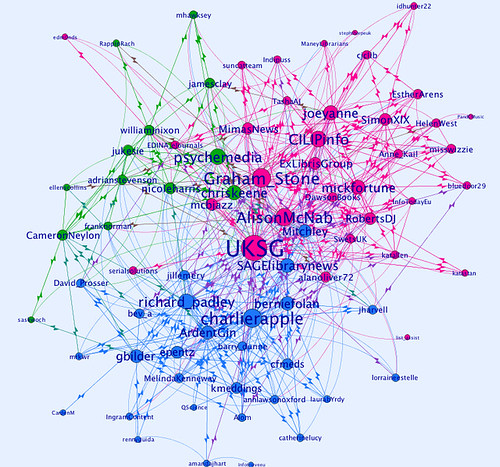
OU lecturer and UKSG speaker Tony Hirst (@psychemedia) put together a nice graphic during this year's conference, to show who was using the #uksg hashtag on Twitter. Check it out below (click on the image to see it in more detail, or see some of his other UKSG visualisations on his Flickr account).

Labels: Conference, flickr, hashtag, twitter, uksg
Wednesday, April 06, 2011
An attempt to capture the OA debate between Alma Swan and Steve Hall
In the red corner: Alma Swan's vision for the future of scholarly communication, and how we might get there: researchers and others can have immediate, fully-linked, reusable, repurposable, no charge, no barriers access to the corpus. Researchers and others wishing to access research outputs (datasets, grey lit as well as journals etc) should be able to roam freely through, picking and choosing what they read and use. Technologies should be able to do the same thing, to help advance research. OA is the answer because: 1, access gaps for researchers will widen as library budgets are further straitened and big deals are cancelled; 2, professional, practitioner, educational communities and private citizens also have an interest and need for this material; PubMed Central's stats show that 40% of usage comes from (what they call) "citizens". Immediate access is important - we must not delay the dissemination of knowledge.
In the blue corner: Steve Hall (IOP) says publishers provide services to authors, editors, readers and librarians but above all to authors - registering, validating, disseminating research. Authors don't pay for these services, libraries do - through subscriptions / licences to journals. This has become a problem as research output has grown (partic in e.g. China), but library budgets have decreased. The big deal still has a role, but multiple business models will be needed to maintain existing level of access in academia, and to extend access elsewhere. Open access is 2 different solutions (green and gold) that can't co-exist. Green OA seeks to make research papers freely available without contributing to their costs. Embargoes allow publishers to recoup their investment but don't widen access; ditching embargoes is unsustainable. Gold OA does contribute to costs of publishing, and makes content immediately and widely available, but funding is haphazard at the moment - we need a collaborative community response. It's still not clear whether OA will deliver savings (Hall dismisses Houghton's study and points to a more "real world" RIN one). IOP is going hybrid and will take fees from gold OA into account when setting budgets and pricing.
Alma agrees with Steve on the issue of scaleability (research output is growing, we need a per-article model) but argues that green is not "unfunded" given the hidden costs covered by academic contribution. Steve responds that publishers charge for the management of the peer review process, not for the piece that is delivered by academia, and cites examples of journals that have seen their subscriptions cannibalised by green OA or delayed access. He argues that depositing manuscripts in a repository is not comparable to publishing, since these manuscripts don't have e.g. reference linking.
Alma says stats show that mandates very quickly achieve 60% deposit, whereas voluntary deposit is about 30%. In 5 years, with more policies, we will be approaching an acceptable level of OA. Several journals have made content freely available online but have seen subscriptions rise, because of broader international visibility. Physics publishers have co-existed for years with ArXiv - what impact has that had on subscriptions in the last 20 years?
Steven cites Harvard's mandate as having achieved only 20% deposit. Policies need to be global and for example China is unlikely to adopt. Publishers are quietly ready to engage with gold OA. Over half of Elsevier's journals are already hybrid. What gets in the way is the continuing fight over short embargo green access. If funders keep pushing it, and publishers keep resisting, the stand off does no-one any good. Better to bring a collection of stakeholders together to review how to facilitate gold OA more quickly. Re. ArXiv, these are pre-prints (not peer reviewed - original author manuscript) and very few journals are comprehensively covered. It is more difficult to make new sales of a journal if a librarian knows most of it is freely available elsewhere.
Alma says that there are several other universities to cite that counter the Harvard example. If mandates aren't working, why are publishers so keen to lobby against them? We cannot ask for gold mandates (no university will do it, not many funders will countenance) so need to pursue policies for green. Publishers will incur costs in transitioning to a per article cost system - each publisher has to decide whether that future is viable.
Unfortunately, not enough time was left for questions from the floor - I bet there were plenty :(
Labels: open access, uksg
Tuesday, April 05, 2011
Goodbye Serials, Hallo Insights!
You've probably all heard the exciting news by now. Announced at today's UKSG AGM, our journal Serials has been renamed "Insights: connecting the knowledge community". This follows feedback indicating that the old title wasn't really doing justice to the wide range of topics we cover. The new title was the winning entry in a competition among UKSG members - big congratulations to our winner, Jane Harvell of the University of Sussex. She will receive her prize (an iPad!) at a presentation just before tomorrow's final plenary sessions.
More details at http://bit.ly/g8euj6 - feel free to share your thoughts, below!
An introduction to ORCID
ORCID (Open Researcher & Contributor ID) started out as a CrossRef initiative that then flew the nest, with the support of Nature and Thomson. It now has stakeholders including funders, researchers and librarians. Geoffrey Bilder, our speaker today, has been seconded from his day job at CrossRef to be the technical director at ORCID.
The general problem: identity is cheap
The problem at the heart of ORCID's being is that, on the internet, identity is "cheap" - it's easy to create multiple different profiles in silos on different sites, leaving every site with a fragmented view of you.
The problem in scholarly communications
The scholarly record is built on understanding the provenance and 'network status' of content. Publisher brands are based on the 'provenance infrastructure' (credentials of author, editorial rigour, peer review, citations). Both CrossCheck (another CrossRef initiative) and ORCID are key to the credibility of the author, although note that it's not just about authors - it refers to "contributor identifiers" to acknowledge all the other roles. One person (one ID) can contribute in lots of different ways (author, reviewer, programmer, compiler) and can have relationships to other IDs (edited by, co-author, colleague etc).
The knowledge discovery problem: name ambiguity
ORCID is about knowledge discovery, rather than access control or security - about people publicising their work, but ensuring it is credited accurately. The main issue is name ambiguity: name variations, name "collision" (multiple people with the same name, eg. the other Geoff Bilder, a Canadian para-ski-glider), name changes, name translations, corporate authors... All complex problems that must be resolved for accurate crediting within scholarly literature. ORCID's mission is to solve this problem through collaboration; various systems exist - economists use RePeC's author claims service, some countries have national databases of researchers - but regional / disciplinary / institutional silos are unhelpful in our networked age. Aspects of identity can be claimed by individuals or asserted on their behalf by institutions; ORCID recognised it needed to bring both organisational and personal assertions together to seed its system as neither level by itself would ensure sufficient uptake to make the service useful.
Principles and progress
ORCID's ten guiding principles (http://www.orcid.org/principles) demonstrate the organisation's non-partisan, international, open approach. The board is made up of "anyone who can commit the time and wants to participate". So what have they done so far?
- Thomson donated codebase for its researcher ID to help jumpstart ORCID
- Various functions were added to this for ORCID's alpha prototype - Thomson's system was based on personal "claims", so the organisational layer had to be added
- Now working out last details for licensing the codebase to build a phase I version of the system
- And planning for future sustainability (funding / staff)
- Hoping to have something that people can use, next year
- Q: Authors are allowed to create profiles - how can IDs remain unique?
A: Authors cannot change the identifier, only the information associated with it. - Q: The contributor ID could become increasingly complex - how do we define where 'contribution' begins and ends?
A: We will studiously avoid defining that - it's going to evolve. But the answer is essentially that people will record what they think is important, and if it's not important, it won't be counted for much. [Given that people will have to take the time to enter this data, they will likely only claim credit for things that are useful / important] - Q: How will this fit with the requirements of REF?
A: It's not clear where REF responsibilities will sit but hopefully ORCID will make the process of gathering information easier. - Q: Pseudonymity?
A: A lot of this information is public already, but in aggregation it's more powerful. What if it becomes too easy to find details about stem cell researchers in Alabama or animal sci researchers in Oxford. People do have good reasons to want to hide information - even just if you want to be credited for peer reviewing without it being public. ORCID will allow any or all information except the identifier itself to be hidden. - Q: What is happening with the development of IDs in different countries?
A: It would be a bad idea to think "ORCID's coming, let's stop working on our system". Other systems will continue to exist and be important. At minimum, ORCID will be able to include information about other relevant identifiers. - Q: What work will be involved for publishers?
A: A classic example: a researcher submitting a manuscript currently fills in all the information each time, and that information quickly becomes stale (e.g. contact data). In future, they will upload their ORCID, and publishers can query and recheck information as necessary. - Q: Who will be the arbiter of who will be attached to a work as a contributor?
A: For example, the corresponding author will have more credibility in saying who else contributed. - Q: Disambiguity of affiliations?
A: We may integrate with e.g. Ringgold to create a controlled vocabulary for organisations. - Q: What are the data protection issues?
A: We are transparent about what is being revealed, to whom, and we give authors control - they can make anything except the identifier private. - Q: What's the long term funding plan?
A: Exactly. The technology doesn't matter if we can't sustain an organisation to keep it running. We are looking at future models, from related service provision to membership.
Labels: Author, Identification, orcid, uksg
Curated tweetstream: what our audience said about Charles B. Lowry on the economic crisis
Here's another first for LiveSerials - rather than writing a report on the session by Charles B. Lowry, Executive Director of the Association of Research Libraries, I thought I'd give you a snapshot of the tweeting that took place throughout:
Setting the scene:
- bookstothesky Telling wordcloud from Lowry re library budgets: key words emphasized are budget, reduction(s), cut, reduced :-/ #uksg
On US vs UK library budgets:
- jharvell Does that mean that 10 universities in the us had library budgets of over 40 million dollars before the cuts? #uksg #didimisssomething?
- chriskeene @jharvell and the lowest category was 'libraries with budget less than $20million'. different world!
- jharvell Don't get me wrong those big budgets are brilliant. Brilliant. But my gob hasn't closed for the last 5 mins. #ineverknew #uksg
- jharvell With the amount of money available in US budgets why are publishers even bothering listening to us in the uk #uksg
On the other hand:
- charlierapple Decreasing budgets are the new norm, not an aberration, with consequences for teaching and research internationally #uksg Lowry
- ORourkeTony @charlierapple #uksg I heard someone say recently that flat was the new up!
- MelindaKenneway Time to head to Canada by the looks of things - they seem to be the only libraries left with budget. #uksg
- antet Not sure I like the detached phrase "reduced commitment to human resources" #uksg
Nurturing innovation, or why we need to kiss more frogs
Sir John O'Reilly, VC, Cranfield University, promises to touch on a number of different topics, seemingly randomly. Which is a handy excuse for a blogger - any randomness that follows was 'im, not me. Sir John is speaking about rebooting UK HE, from the perspective of the VC of a wholly postgraduate STEM university (he gives yet another definition of the M in ST(E)M - in this case, management).
He starts by noting that, in recent news stories, "students" and "higher education" have almost entirely meant undergraduate - even HEPI's Higher Education Supply and Demand document was focussed on undergraduate demands and provision. HEFCE funding per student fell substantially through the 1990s, despite the government's recognition of the importance of the knowledge economy, and we now know that several universities will begin charging high-end fees from next year. Only undergraduate students can access the Student Loans Company's "favourable" arrangements; what will the climate be for postgraduate students?
Sir John uses Langton's Ant to demonstrate emergence, as a cipher for the complexity of the higher education system: a simple algorithm at the heart of a complex system that generates unpredictable behaviour and unintended consequences. For example, the line between teaching and research is convenient but arbitrary, and the two are symbiotic - weaken the research base, and the teaching will be poor. But likewise: weaken the teaching base, and the research will be poorer.
Drawing this together, Sir John asserts that the changes in funding of postgraduate education may have the unintended consequence of weakening the research output of our universities - which in turn will weaken innovation, which will in due course weaken the economy. "The princess and the frog" can be used as metaphor for knowledge transfer; to find a prince, you have to kiss a lot of frogs. We must be careful not to disrupt inappropriately the research and innovation agenda and our ability to address it in England. "We are in the business of kissing frogs, to ensure that the future generation has its princes of wealth creation." As Jane Harvell, one of UKSG tweeters puts it, "all this is not news for us working in HE, but it does need saying, and is best said by a Vice Chancellor."
Labels: consequences, economy, emergence, he, innovation, knowledge, postgraduate, uksg, unintended
Do the math: PDA not the answer?
Yesterday, we talked about filtering; today, Terry Bucknell suggests, we're looking at the opposite - buying by the bucketful. A multidisciplinary university like Liverpool (where Terry is e-resources manager) buys a wide range of content, for example, 19 ebook packages in 5 years. These have traditionally been bought with leftover budget at the end of the financial year (n.b. Liverpool decided ebook packages are better than journal backfiles here). As "leftover budget" becomes a thing of the past, Terry is analysing the value from these packages in more depth and always considering alternative purchasing models - individual title selection, patron-driven acquisition, etc.. Here are some highlights of Terry's analysis:
- 40% of Liverpool's e-resource usage is e-books - yet 95% of the budget goes on journals.
- Liverpool's usage is typical - approx 40% of titles in a collection are used in the first year; approximately 60% have been used by the second year
- Some subjects (e.g. mathematics, at Liverpool) seem to perform badly - is this a factor of how/when information is used in different disciplines? need to be careful before making collection development decisions based on this data
- All types of books get used at least a bit, but some content (e.g. conference proceedings) is used more than other content (e.g. monographs)
- Pareto principle applies! 80% of downloads from top 21% of ebooks - Terry doesn't think this should be a factor in how collections are purchased / priced. (Looking more closely, 35% of usage on one platform came from one title! - doesn't tell you anything about the broader collection, just that some books are heavily used)
- Even on aggregator platforms (where there's a greater level of individual title selection than a publisher package), a third of ebooks have had only 1 or 2 accesses during 2 years
- With patron-driven acquisition, all ebooks are used (because you don't buy them unless they are) - so should be better value? Terry used ebrary model (purchase triggered by 10 page turns / 10 minutes in a title / copy & pasting / printing) to analyse Liverpool's Springer ebook usage stats and calculated that PDA costs would overtake package costs in just one year in most cases (even when cheaper backfiles were excluded from analysis).
- Evidence from elsewhere (e.g. U Iowa ebrary pilot) also shows that PDA budgets run out quickly - libraries who started trials had to resort to buying packages after all
- ... other PDA models are available ... (and may show different results) but Terry found that a PDA model would have to allow for "6 chapters free" before it would be comparable to package pricing.
- Some packages are better value than others, and libraries should prioritise these in collections
- Aggregated databases give cheap critical mass
- Single title selections are important for core texts
- PDA can fill the gaps, but not form the foundations
- Need to centralise book budgets - stop fragmenting by formats etc - a hard sell for lots of faculty / librarians
- Rapid move to e-only book acquisition - implications for logistics / staffing
- Packages need to be at least 50% discount for it to be worth it for the library - make it a "no brainer" (70% discount) for the library to purchase, and you'll solve the budget crisis
- Offer combined books / journals packages with appropriate cost weighting / discounting.
Labels: analysis, database, ebooks, model, package, pda, purchasing, uksg
Monday, April 04, 2011
Starting UKSG in a state of ... informed bewilderment
"The future is already here, it's just not evenly distributed." John Naughton (Observer columnist and OU academic) opens with this striking William Gibson quote, reminding us that you only discover new things if you know where to look and are willing to pay attention. We're in a state of "informed bewilderment", with no idea how the internet revolution will pan out, so should stop trying to predict the future, and pay attention to what's already here.
Dissolving value chains
This is either an exciting, fulfilling & rewarding time ... or a traumatic experience that is likely to be destructive to some well-established businesses (even industries). The internet is "a vast global machine for springing surprises ... a phenomenal enabler of disruption." (Read Barbara von Shewick's "Internet Architecture and Innovation", Jonathan Zittrain's "The Future of the internet - and how to stop it" or John's own "A brief history of the future"). In programming terms, "disruption is a feature, not a bug". It cuts out the middlemen that have been such an enduring feature of our economy - journalists, travel agents .. and librarians, and publishers? "The net dissolves value chains" - where once journalism and classified advertising had a happy marriage, now one is helped by the internet and the other is disrupted. It's impossible to predict when open access will overtake closed access in the scholarly ecosystem, but the direction of funding etc indicates clearly where we're headed, so we need to pay attention to the existing change.
An increasingly complex ecosystem
The scholarly ecosystem has grown complex in its proliferation (of publishers, authors, institutions etc), and "for a system to be viable, it has to match the complexity of its environment." But there's not a single organism in our ecosystem able to match the complexity of our environment. Complexity is the new reality, and complex systems are intrinsically unpredictable. The banking crisis warns us of the dangers of being dependent on a system so complex that few people understand it, a system that is too complex to be modelled, too complex to be understood.
The avalanche of data in science
Librarians' functions have traditionally been determined largely by the physical aspects of materials and their housing. Value and roles were clear in the print ecosystem, whereas now, many students don't visit the physical library. Teaching, scholarship and research increasingly take place in a digital environment; librarians will need to move to where the action is ("from place to space"). The traditional information skills will need overhauling. Cornell's "Seven Steps of the Research Process" starts with encyclopedias and catalogues and only fleetingly, in step 5, refers to finding "internet resources". This already doesn't reflect how students behave. We need to adjust to new realities in science, which is becoming more data intensive. John closes by quoting Alan Kay: "The best way to predict the future is to invent it."
Labels: data, future, internet, libraries, science, uksg, value
Tuesday, January 19, 2010
Calling for New Editors for Serials
Long-standing Serials editors, Hazel Woodward (Cranfield University) and Helen Henderson (Ringgold) are planning on retiring at the end of the current volume in 2010. Consequently, UKSG is looking for expressions of interest for new co-Editors to step up to the plate and continue building on the legacy that they have established over the last decade.
Deadline is Feb 12th, and more information can be found here: http://www.uksg.org/serials/neweditors
You can get more information about the journal itself here: http://www.uksg.org/serials or at http://uksg.metapress.com (for details on the content). You could also email me if you would like further information before making an approach to UKSG in the first instance - bev.acreman@biomedcentral.com .
It's a great opportunity and would suit people who are dynamic, well connected and well travelled. Much like Hazel and Helen!
Deadline is Feb 12th, and more information can be found here: http://www.uksg.org/serials/neweditors
You can get more information about the journal itself here: http://www.uksg.org/serials or at http://uksg.metapress.com (for details on the content). You could also email me if you would like further information before making an approach to UKSG in the first instance - bev.acreman@biomedcentral.com .
It's a great opportunity and would suit people who are dynamic, well connected and well travelled. Much like Hazel and Helen!
Labels: journal publishing, serials-enews, uksg
Tuesday, May 05, 2009
Twitter: waste of time or worth it?
Back in March, at the start of UKSG's annual conference, Todd Carpenter of NISO wrote this interesting LiveSerials posting about Twitter and how it is used during conferences.
Today this subject is raised again by CrossRef's Kirsty Meddings, writing the editorial in the latest edition of Serials-eNews, UKSG's news bulletin. (Note that access to Serials-eNews is usually an exclusive benefit for UKSG members but all being well you should get access to this article by following this link - let us know if you have any problems!).
Both pieces are useful in helping to explain why Twitter is gaining such traction in our community, and both are generally in favour of Twitter as a channel for sharing resources and building relationships during conferences. Do you agree? what about using Twitter outside of the conference centre - are publishers, libraries and others in our sector putting it to good use, or wasting their time?
UKSG has set up its own Twitter channel, @uksg, and encouraged usage of the #uksg09 hashtag during the conference. Are we right to be exploring this medium? What more could or should we be doing? We're interested to know your thoughts so please do discuss via comments or trackbacks (or on Twitter! - #uksg).
Today this subject is raised again by CrossRef's Kirsty Meddings, writing the editorial in the latest edition of Serials-eNews, UKSG's news bulletin. (Note that access to Serials-eNews is usually an exclusive benefit for UKSG members but all being well you should get access to this article by following this link - let us know if you have any problems!).
Both pieces are useful in helping to explain why Twitter is gaining such traction in our community, and both are generally in favour of Twitter as a channel for sharing resources and building relationships during conferences. Do you agree? what about using Twitter outside of the conference centre - are publishers, libraries and others in our sector putting it to good use, or wasting their time?
UKSG has set up its own Twitter channel, @uksg, and encouraged usage of the #uksg09 hashtag during the conference. Are we right to be exploring this medium? What more could or should we be doing? We're interested to know your thoughts so please do discuss via comments or trackbacks (or on Twitter! - #uksg).
Labels: serials-enews, twitter, uksg, uksg conference, uksg09
Friday, May 01, 2009
Save the date: 33rd UKSG Annual Conference
A quick note to remind you that next year's UKSG Annual Conference will be held at the Edinburgh International Conference Centre from 12-14 April 2010. Please stick the date in your diary and be sure to join us there!
Labels: Conference, uksg, uksg10
Tuesday, April 28, 2009
UKSG Research - please send us your views!
We recently surveyed delegates at UKSG's 2009 conference in Torquay to find out more about them, what they thought and what they needed from the organisation. We would welcome your input into this discussion. The survey should not take longer than ten minutes and all feedback is valuable.
Tell us what you think
Labels: uksg, user surveys
Monday, March 30, 2009
Lift off: opening of the 32nd (not the 31st) UKSG annual conference
We've all made it (just about) and the auditorium is packed as retiring chair Paul Harwood steps up and taps the mike. Paul welcomes us all and in particular thanks our student attendees, the committee and the exhibitors - pleased to see we've still got such a full exhibition hall despite 'the current climate'. Paul hands over to NASIG president Jill Emery who gives us an update on activities across the pond.
Jill references Twitter and as I sit here the Twitter channels are already going mad with #UKSG09 updates. I've got that UKSG flutter in my stomach - here we go again!
Labels: Conference, nasig, uksg, uksg09
Thursday, March 26, 2009
Counting down ... your blogging team and Twitter tags!
A quick note to confirm that LiveSerials will be springing back into action again over the next few days as the 31st UKSG Annual Conference gets going down in sunny Torquay.
Your blogging team this year:
As usual we're looking forward to your feedback via the blogs comments and now via Twitter. Join us there in spirit if not in person!
Your blogging team this year:
- Bernie Folan (SAGE)
- Bev Acreman (Taylor & Francis)
- Charlie Rapple (TBI Communications)
- Ginny Hendricks (Ardent Marketing)
- Jill Emery (University of Texas Libraries)
- Karen Halliday (Wiley-Blackwell)
- Kirsty Meddings (CrossRef)
- Laura Woods (City University)
- Mandy Phillips (Edgehill University)
- Mark O'Loughlin (SAGE)
- Nadine Edwards (University of Greenwich)
- Todd Carpenter (NISO)
As usual we're looking forward to your feedback via the blogs comments and now via Twitter. Join us there in spirit if not in person!
Labels: blog, Conference, twitter, uksg, uksg09
Tuesday, March 17, 2009
Fancy joining the blogging team?
We're once again counting down the days to the UKSG's annual conference - registrations are closed and we're expecting another mammoth number of delegates to be descending on sunny Torquay at the end of this month for a couple of jam-packed days of learning, sharing, networking ... and blogging.
As ever, we'll be reporting back on all the action here on the LiveSerials blog. If you fancy joining us in our prime bloggers' seats, then do drop me a line. You don't need to be an experienced blogger (we'll provide all the instructions you need to get started), and you don't even need to have a laptop with you at the conference - we'd also welcome follow-up thoughts and opinions once you're safely back at your desk.
If you want to get a flavour of how we roll, take a look at some of the postings from previous conferences - 2006, 2007 and 2008.
As ever, we'll be reporting back on all the action here on the LiveSerials blog. If you fancy joining us in our prime bloggers' seats, then do drop me a line. You don't need to be an experienced blogger (we'll provide all the instructions you need to get started), and you don't even need to have a laptop with you at the conference - we'd also welcome follow-up thoughts and opinions once you're safely back at your desk.
If you want to get a flavour of how we roll, take a look at some of the postings from previous conferences - 2006, 2007 and 2008.
Labels: blog, Conference, uksg, uksg09
Monday, April 21, 2008
Your ideas, please!
While the conference and its myriad of blog postings is fresh in everyone's memory, we'd like to ask for your input on a related subject.
The UKSG publishes an Open Access e-book called "The E-Resource Management Handbook", which is intended to be an evolving source of comprehensive support for information community practitioners. The Handbook has been well-reviewed and currently covers subjects such as:
New chapters are commissioned on a regular basis to address emerging issues - we are seeking to ensure that it remains current and relevant to readers with different regional and professional perspectives. So we invite you to contribute suggestions for new chapters. For example:
The UKSG publishes an Open Access e-book called "The E-Resource Management Handbook", which is intended to be an evolving source of comprehensive support for information community practitioners. The Handbook has been well-reviewed and currently covers subjects such as:
New chapters are commissioned on a regular basis to address emerging issues - we are seeking to ensure that it remains current and relevant to readers with different regional and professional perspectives. So we invite you to contribute suggestions for new chapters. For example:
- Could you identify discrete aspects of your profession (whether that is librarianship, publishing, marketing, technology, information management...) to which you, or your colleagues and peers, could use a practical guide?
- Have you recently sought information about a topic only to find the current literature is inadequate, out-of-date or irrelevant to your particular needs?
- Is there an area in which you have expertise from which you think the wider community could benefit?
- Are you aware of emerging technologies, new product categories, evolving business functions or changing supply chain processes that need to be documented?
- Would you say there are developments outside of our core community (e.g. political, economic, social, technical, legal, environmental) which nonetheless have an impact on our activities and could usefully be assessed within our context?
Labels: e-resource, e-resource management, e-resource management handbook, uksg